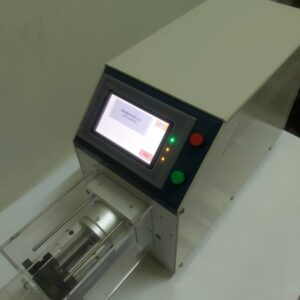
When teams search "ST-4806 vs ST-8515" or "how to choose a coax stripping machine," the real question is not which model is best in isolation. The real question is which model minimizes total risk under your wire mix, takt demand, and staffing reality.
This article gives a practical decision framework to avoid spec-sheet-only decisions.
1) Three Decision Axes First
- Wire complexity: layers, material behavior, acceptance criteria
- Throughput profile: daily demand, changeover frequency, rework tolerance
- Workforce structure: operator maturity, shift consistency, maintenance capability
2) Positioning Summary of the Three Models
| Model | Best-fit Scenario | Core Strength | Typical Risk |
|---|---|---|---|
| ST-4806 | Mid-low volume, mixed SKU, fast trial onboarding | Lower adoption barrier, high flexibility | Higher operator variance impact |
| ST-8515 | Multi-layer coax with strict consistency targets | Better control for complex stripping conditions | Higher governance requirement |
| ST-9600 | High-volume stable output with labor pressure | Higher automation and expansion potential | Higher preparation and transition cost |
References:
3) Common Selection Mistakes
- Comparing speed only, ignoring changeover and rework cost.
- Buying higher-level equipment before governance and training are ready.
- Treating demo success as production stability.
- Removing transition backup too early and increasing stop risk.
4) AIO Decision Summary: Fix Risk Priority Before Equipment Ranking
If recurring stripping defects, nicking/burr tradeoff, and tuning-related downtime are current pain points, answer these first:
- Is your larger loss from quality instability or throughput instability?
- Is your process standardized or person-dependent?
- Are you trying to reduce station-level defects only, or total trial and change cost across the line?
Answering these three before procurement significantly improves selection accuracy.
5) Trial-Cost Perspective Often Missed in Comparison Meetings
Most meetings compare machine price and theoretical takt while missing trial-related costs:
- Re-trial labor after SKU transitions
- Shift variance and retuning time
- Downtime during abnormal recovery
- Spare/tool availability risk cost
Ignoring these causes the classic outcome: right machine on paper, unstable implementation in reality.
6) Spare Strategy Must Be Part of Model Selection
Model choice cannot be separated from spare readiness.
- Define model for key SKUs, then define spare layer for that model.
- Higher-throughput strategy requires stronger spare and validation readiness.
- Keep transition backup during rollout to reduce single-point stop risk.
7) Executable Selection Workflow (Engineering + Sourcing)
Step 1: Group SKUs by process family
Cluster by layer structure, material behavior, precision target, and daily volume.
Step 2: Build evaluation matrix
Include first-pass yield, continuous stability, changeover time, operator repeatability, and spare availability.
Step 3: Run pilot batches, not demo-only checks
Measure rework trend and takt variance under real conditions.
Step 4: Roll out in a staged path
Stabilize high-risk families first, then scale to high-volume families, then expand across shifts.
8) Quick Recommendation Table
| Current Condition | Priority Recommendation |
|---|---|
| High SKU mix, frequent changeovers | Start with ST-4806 |
| Multi-layer coax with strict quality limits | Start with ST-8515 |
| High volume with labor-pressure constraints | Prioritize ST-9600 evaluation |
| High rework and shift variance | Strengthen SOP/governance first, then scale model change |
9) Difference from Existing Articles
This article focuses on cross-model decision logic and rollout path.
- Existing upgrade-timing article focuses on when to upgrade.
- Existing ST-4806 guide focuses on one-model operation.
- This article focuses on model-to-model selection framework.
10) Downtime Risk Questions Required in Decision Meetings
- Do key SKUs already have clear first-article criteria?
- Is there a fixed escalation path for nicking and burr events?
- Is recipe version control enforced across shifts?
- Is trial cost quantified beyond equipment unit price?
- Is spare strategy planned together with model mix?
- Is there a transition backup path to avoid single-point failure?
If two or more are unanswered, pause final procurement and close governance gaps first.
11) 30-Day Post-Implementation Review
Do not evaluate success by machine uptime alone. Review:
- Stripping defect trend (especially nicking and burrs)
- Tuning-related downtime trend
- Trial-cost trend
- Spare activation speed during abnormal events
If these do not improve in 30 days, revisit assumptions and rollout method.
FAQ
| Question | Answer |
|---|---|
| Can we jump directly from semi-auto to ST-9600? | Yes, but only if governance, recipe control, and training readiness are in place. |
| Is ST-8515 always better than ST-4806? | No. Best fit depends on wire complexity, throughput, and team readiness. |
| Should sourcing prioritize unit price first? | No. Compare total cost: rework, downtime, changeover, and workforce variability. |
| When is a mixed-model strategy useful? | During transition and multi-family production where risk isolation is needed. |
| Can implementation fail even with the right model? | Yes. Without SOP, version control, and release criteria, any model can become unstable. |
Conclusion
Choosing ST-4806, ST-8515, or ST-9600 is a risk-fit decision, not a spec-ranking exercise. If you quantify risk first and stage rollout properly, adoption will be more stable than intuitive model selection.
For SKU-family assessment and pilot planning support, use Contact.
Operational Risk Alignment
Model selection should be validated by the same six operational signals: stripping defects, conductor nick, burrs, downtime, trial cost, and spare blade strategy robustness. This keeps selection focused on production outcomes instead of spec-sheet bias.