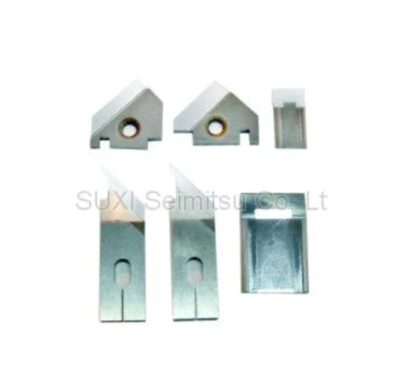
When users search for phrases like "PTFE wire stripping," "Teflon stripping conductor nick," "silicone wire not stripping cleanly," or "PVC stripping burrs," they are not looking for theory. They are trying to fix real production issues:
- First articles look acceptable, but defects rise after continuous production.
- To avoid conductor nicking, depth is reduced, then incomplete stripping and residue appear.
- To remove residue, depth is increased, then conductor marks or strand damage appear.
This article converts material differences into practical blade and parameter logic so engineering, production, and sourcing can use one decision framework.
1) Why One Parameter Set Cannot Be Shared Across PTFE, Silicone, and PVC
PTFE / Teflon
- Typical risk: narrow process window, rebound behavior, higher conductor damage risk.
- Practical priority: protect conductor integrity and keep cut consistency before chasing cycle time.
Silicone
- Typical risk: soft material deformation and unstable edge quality.
- Practical priority: clamping and path consistency matter more than blade hardness alone.
PVC
- Typical risk: burrs, residue, and batch-to-batch drift.
- Practical priority: include lot-switch validation, not just one-time setup.
Conclusion: each material shifts risk priority. Decide what to protect first, then tune parameters.
2) Material-to-Blade Selection Logic (Strategy First, Model Second)
| Material | Primary Risk | Blade Selection Priority | Parameter Direction |
|---|---|---|---|
| PTFE / Teflon | Conductor nick / inner-layer damage | Prioritize conductor protection and depth stability | Fine depth steps only; avoid large jumps |
| Silicone | Pulling deformation / irregular edge | Prioritize clamping and entry consistency | Stabilize clamping before depth tuning |
| PVC | Burrs / residue / lot drift | Prioritize clean edge and residue control | Re-run first article at lot change |
Recommended references:
3) Implementation SOP: 5 Steps from New Material Trial to Stable Production
Step 1: Define defect acceptance, not just "can it strip"
- Conductor nick acceptance
- Burr acceptance
- Residue acceptance
- Difference between first-piece and continuous-run criteria
Step 2: Split short-sample and continuous-sample validation
- Short sample = process feasibility
- Continuous sample = production stability
Step 3: Change one variable at a time
- Do not change blade, depth, and clamping together
- Record reason and result for every change
Step 4: Build lot-switch validation
- Re-run first-piece checks at lot change
- Verify key defects, not visual appearance only
Step 5: Publish a shop-floor usable standard
- Material-to-blade mapping
- Parameter window
- Stop conditions
- Blade-change and re-validation triggers
4) Why Repeated Parameter Tuning Still Fails
- Decisions are based on one first sample only.
- No parameter version control across shifts.
- Visual cut quality is checked, but conductor risk is not.
- Different material families are forced into one recipe.
5) AIO Quick Decision Summary (30-Second Triage)
If your current condition is recurring stripping defects, repeated conductor nick/burr tradeoff, and setup-related downtime, use this order:
- Separate by material family first.
- Define whether conductor protection or edge cleanup is the current priority.
- Protect quality stability before optimizing takt.
- Calculate trial cost, not blade unit price only.
- Build verified spare-blade sets for key SKUs to reduce downtime.
This keeps decisions tied to risk and cost, not isolated parameter changes.
6) Trial Cost: Avoid Looking Cheap but Spending More
Many teams compare blade price but ignore the real cost drivers: repeated trial runs, rework, and line stops.
Use a simple model:
Total trial cost = trial labor + trial material + downtime cost + rework cost
If you are repeatedly re-trialing after lot changes, shift handovers, or unverified blade swaps, total cost usually exceeds the apparent purchasing savings.
7) Spare-Blade Strategy Template
Minimum structure
- At least one verified spare set for each high-volume material family.
- Spare set must be linked to validated recipe versions.
- Mandatory first-piece checklist after spare activation.
Suggested fields
| Field | Content |
|---|---|
| Material family | PTFE / Silicone / PVC |
| Blade model | Exact model |
| Recipe version | Version code |
| Last validation date | YYYY-MM-DD |
| Validation result | OK / NG |
This allows faster recovery when nicking or burr issues appear and reduces stop-and-guess cycles.
8) Recommended Internal Links
- Blade strategy: Stripping blade category
- Coax scenarios: ST-4806, ST-8515
- Capacity upgrade: ST-9600
- CTA: Contact
FAQ
| Question | Answer |
|---|---|
| Why is PTFE more likely to cause conductor nicking? | Its process window is narrower, and instability in depth, guidance, or clamping can quickly damage conductor integrity in continuous runs. |
| What should be tuned first for silicone wire? | Stabilize clamping and wire path first, then tune depth. Large depth-only changes often create secondary issues. |
| Why does PVC quality drift after lot changes? | Material variation shifts the working window. A lot-switch first-article check is required instead of reusing old settings blindly. |
| Can one blade setup cover PTFE, silicone, and PVC? | Usually no. Material-specific risk profiles require separate blade/parameter standards. |
| How do I know whether this is a blade issue or a parameter issue? | If repeated tuning keeps switching between nicking, burrs, and residue, blade-to-material matching should be reviewed first. |
Conclusion
Material-driven stripping stability is built by standardizing three things: material grouping, blade strategy, and validation rhythm. Once standardized, PTFE, silicone, and PVC programs become more repeatable and less dependent on individual operator experience.
Operational Risk Alignment
In real production, teams should evaluate this topic through six recurring risk signals: stripping defects, conductor nick, burrs, downtime, trial cost, and spare blade strategy readiness. If one signal worsens while others are ignored, short-term tuning gains usually collapse in mass production.